Inside Our Entrepreneurship Classes for Teens: How Students Build Confidence and Real Skills
Updated: Dec 17, 2025

When parents imagine an “entrepreneurship class,” they often picture worksheets, lectures, or sitting quietly while someone talks about business concepts. At Launchpad Juniors, the classroom looks nothing like that.
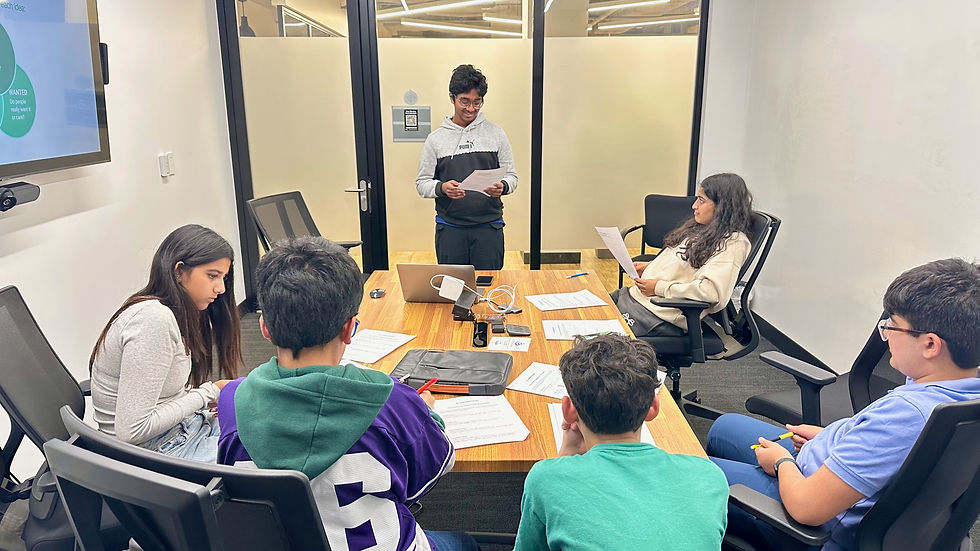
Our students spend each week presenting, testing, debating, building, experimenting, and improving their ideas in a real boardroom environment. This article gives you an inside look at how our hands-on method transforms shy students into confident presenters and curious thinkers into young innovators.
Weekly Pitch Practice in Our Entrepreneurship Classes for Teens
One of the most unique parts of the Launchpad Juniors curriculum is our weekly pitch cycle.
Every week, students step to the front of the room and deliver a short pitch on what they worked on:
a new idea
a revised prototype
customer feedback
lessons learned
next steps
This repeating ritual does something powerful:
Students become confident communicators, one pitch at a time.
Even students who begin the program nervous about public speaking quickly realize that pitching is just storytelling - sharing what they discovered and what they built.
The practice is intentionally low-pressure but incredibly effective. Students get comfortable with:
standing in front of others
structuring ideas
answering questions
explaining decisions
handling feedback
These are the same skills adults use in boardrooms every day.
Learning Through Doing: Why Our Entrepreneurship Classes for Teens Feel Like Startup Labs
Entrepreneurship isn’t a memorization subject; it’s a skills subject.That’s why our classroom feels more like a mini startup incubator than a traditional course. Inside our entrepreneurship classes for teens, students learn by doing - through weekly pitching, customer feedback, and hands-on product building.
Here’s what a typical session looks like:
1. Hands-on Learning (15 minutes)
Every week begins with a short, practical lesson such as:
How to define your ideal customer
How to run customer interviews
How to analyze feedback
How to build a simple MVP
How to refine your pitch
Lessons are short and instantly applicable - students use the concepts that same day.
2. Student Work Time (20 minutes)
Students apply what they learned by working on their products:
sketching prototypes
editing pitch slides
refining features
making pricing decisions
carving, 3D printing, sewing, or assembling their MVPs
practicing their pitch in pairs
The room buzzes with energy - students walk around interviewing each other, debating ideas, and refining their work like real creators.
3. Pitch Time (25 minutes)
Each student presents:
their idea
what changed from last week
what they tested
what they learned
what they’re planning next
The class gives feedback using our friendly “Start, Stop, Continue” method.
Over time, we see remarkable changes:
The quietest students start raising their hands.
The boldest students learn to structure their thoughts.
Everyone starts asking smarter questions.
4. Founder Reflection (Last 10 minutes)
Every session ends with a guided debrief:
What surprised you today?
What feedback did you get?
What would you change next week?
What action will you take before the next class?
Students learn the core entrepreneurial truth:
Your first idea will not be your final idea - and that’s a good thing.

Iterating on Ideas: When Students Discover That Failure Is Data
One of the most exciting moments for our Fall 2025 cohort happened around Week 3–4, when students realized:
some of their ideas were too complicated
some were too expensive
some didn’t resonate with customers
some needed a new direction
For most teens, this was their first time understanding that iteration is not failure - it’s progress.
During interviews with customers, students found:
assumptions were wrong
features needed to change
designs had to be simplified
pricing needed to adjust
This is exactly how real startups operate and our students lived that experience firsthand.
A Supportive Environment That Encourages Growth
The boardroom setting at Venture X Ashburn plays a major role in shaping student behavior.
Students don’t feel like they’re “in class.” They feel like they’re building something meaningful.
The environment encourages them to:
speak professionally
listen actively
collaborate respectfully
think like creators
ask deeper questions
We’ve seen students who were shy at first begin leading discussions by Week 4. We’ve seen students start helping each other solve problems without being asked. We’ve seen friendships form around creativity and shared goals.
This is what experiential learning does - it brings out the best in young minds.
The Confidence Transformation
By the time students reach the final pitch day, their transformation is unmistakable:
They speak clearly.
They organize thoughts logically.
They respond calmly to questions.
They embrace feedback rather than fear it.
They know how to present to adults.
Confidence is the #1 outcome of this program, even more than the final product.
Final Thoughts
A Launchpad Juniors classroom is not about lectures or memorizing business terms. It’s about giving teens the space, structure, and support to:
build
test
think
revise
speak
and grow
Inside our classroom, students learn not only how to create products - they learn how to express themselves, how to bounce back from setbacks, and how to believe in their own ideas.
This is entrepreneurship education the way it should be: hands-on, engaging, and transformative.

Comments